
Glossary |
Astronomical Formulas |
updated: 2026-06-03 |
A collection of useful astronomical formulas.
Coordinate Conversions (see also Coordinate Converter - Deep Space Place):
DECdms to Degreedecimal

where
DECh = hour part of DECdms
DECm = minute part of DECdms
DECs = seconds part of DECdms
This formula will convert a DEC coordinate string like 42° 01' 45.726" to 42,0293683°
R.A.hms to Degreedecimal

where
RAh = hour part of R.A.hms
RAm = minute part of R.A.hms
RAs = seconds part of R.A.hms
This formula will convert a R.A. coordinate string like 13h 15' 49.27385" to 198,955307708333°
Greenwich Mean Sidereal Timedeg or GMSTdeg from JulianDate (JDate)
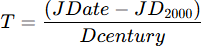 : The number of Julian centuries (each = 36525 days) that have passed since the epoch J2000.0
where:
JDate = the Julian Date for which you want to compute GMST
JD2000 = 2451545 : Julian Date of J2000.0 (January 1, 2000, 12:00 TT)
Dcentury = 36525 : number of days in one Julian century

where:
d1 = 67310.54841 : GMST at 0h UT on 1 January 2000 (J2000.0), expressed in seconds
At 2000‑01‑01 00:00:00 UT, the sidereal time in Greenwich was:
18h41m50.54841s
Converted to seconds:
18⋅3600+41⋅60+50.54841=>67310.54841
d2 = 8640184.812866 : Linear rate of increase of GMST per Julian century, in seconds
It accounts for:
No of seconds per sidera day: ~86164.0905 seconds
Over 36525 days (one Julian century), GMST accumulates
Plus precession of Earth’s rotation axis
Plus small corrections from Earth rotation irregularities
d3 = 0.093104 : Quadratic correction term accounting for long‑term changes in Earth’s rotation.
It accounts for:
Tidal braking of Earth’s rotation
Redistribution of mass inside Earth
Long‑term secular variations
d4 = 0.0000062 : Cubic correction term for very long‑term rotational drift.
It models extremely slow, long‑term changes in Earth’s rotation rate.
Its effect is tiny for modern dates but necessary for accuracy over ± several centuries
h100 = 876600 : 100 years * 265,25 days * 24 hours
sph = 60*60 = 3600 : seconds per hour
sper° = 60*60* 24/360° = 240 : Sideral Seconds Per Degree
The result must be normalized to keep it within the 360° boundary.
Created with the Personal Edition of HelpNDoc: News and information about help authoring tools and software